How to Buy Domain Names for Affiliate Marketing Success

You spend weeks building an affiliate site. You write helpful content, pick the right products, and set up your pages. But you grab a messy domain name like "bestgadgets2026.wordpress.com" or a random .xyz address. Suddenly, no one clicks. They don’t trust you.
Here’s the thing: your domain name is your first asset. It’s the first thing people see before they read a single word. And it directly affects how much they trust you.

Research from 2026 shows that 77% of consumers say trust is damaged when other brands use the same name at a different domain extension (source). That means if someone sees your site as "myaffiliatesite.net" and a similar name exists at ".org" or ".info," they question your legitimacy. You lose credibility before you even start.
Yet most entrepreneurs overlook domain strategy. They grab whatever is cheap or available without thinking about the future. That leads to problems later when you want to scale. You end up juggling messy domains, confusing your audience, and struggling to build real brand recognition.
In 2026, brand authority matters more than ever for affiliate marketing success. A clean, relevant domain name helps you stand out and build trust from day one. It also makes it easier for Google to understand what your site is about, which helps your SEO.
This guide gives you a structured, automated approach to domain names buy decisions for multiple sites. You’ll learn how to pick the right names, automate the buying process, and avoid common mistakes that hurt your growth. Whether you’re planning to build one site or a network of affiliate properties, getting your domain strategy right saves you time, money, and headaches down the road.
Ready to treat your domain like the asset it really is? Let’s start with the basics of choosing a name that works for your business. But first, if you’re new to building an affiliate income stream, check out our affiliate marketing business basics guide for a solid foundation.
Why Domain Names Are the Foundation of Affiliate Marketing Success
So we know a bad domain kills trust. But what makes a domain actually work for you? Let’s break it down into three big reasons why your domain name sets the stage for everything else.
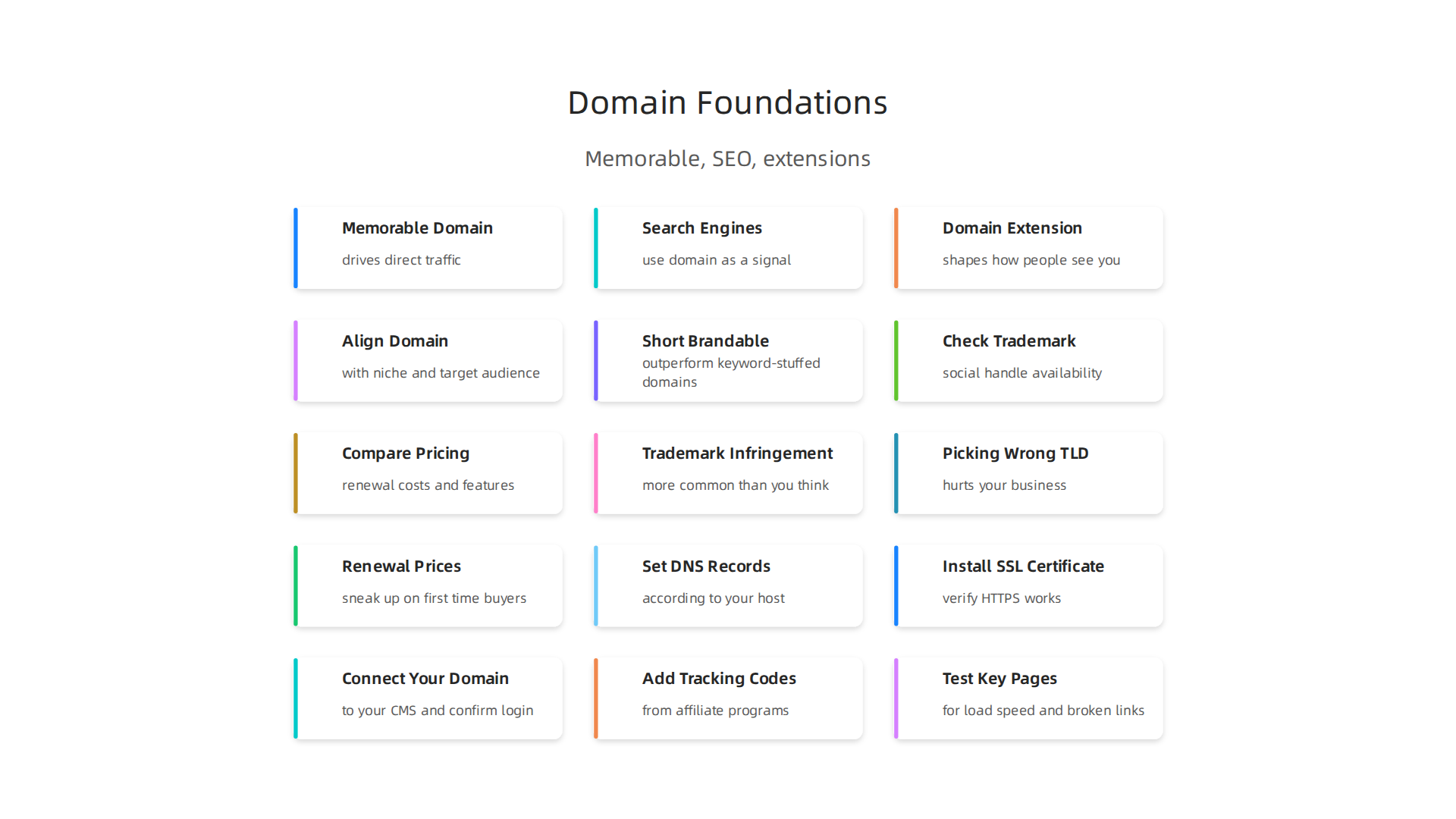
A memorable domain drives direct traffic. When someone remembers your site name without searching for it, that is pure gold. Think about it. If your site is something like "bestkitchengearfor2026.com" versus "KitchenSmartHub.com," which one sticks? The shorter, cleaner one wins every time. People type it straight into their browser or share it with a friend. That direct traffic is free and highly converting. Plus, a name that makes sense helps your brand stay in their head. And when they forget your exact URL and search instead, a strong brand name shows up in the results anyway. HubSpot’s 2026 marketing statistics show that top-of-mind awareness is a huge factor in repeat visits.
Search engines use your domain as a signal. Here is something most beginners miss. Google looks at your domain name to figure out what your site is about. If your domain includes relevant words, it gives you a small ranking boost. Not a huge one, but every little bit helps. Also, older domains (ones registered years ago) tend to rank better than brand new ones. That is why buying an aged domain can jumpstart your SEO. But you can also start fresh and let age work in your favor over time. According to WordStream’s 101 SEO stats for 2026, domain authority and age remain important trust signals for search engines. Just make sure to check domain expiration dates regularly so you never lose your hard-earned ranking.
Your domain extension shapes how people see you. That simple ".com" versus ".net" or ".xyz" makes a real difference. Most internet users still trust ".com" the most. They assume a ".com" site is more established and legitimate. If you use a weird extension like ".info" or ".biz," some people hesitate to click. Worse, if someone else has the same name at a different extension, confusion kills trust. Research from 2026 shows that 77% of consumers say trust is damaged when other brands use the same name at a different domain extension (source). So grab your exact name as a ".com" first, and protect your brand by buying the other common extensions too.
Actually, here is a simple rule. If you are building an affiliate site in 2026, go with a ".com" that is short, memorable, and includes a topic word. That combination works best for SEO, trust, and click-through rates. It is the foundation your whole business sits on. If you want to move your domain between providers later, here is how to transfer your domain name from GoDaddy to Squarespace in 2026 without breaking anything.
Your domain is not just a web address. It is your first impression, your SEO anchor, and your brand’s home base. Get it right, and everything else gets easier. Get it wrong, and you fight uphill from day one.
Key Factors to Consider Before Buying Your Domain
Buying a domain is not just about picking something that sounds okay. You need to think ahead.

A smart choice now saves major headaches later. Here are the most important things to check before you click "purchase."
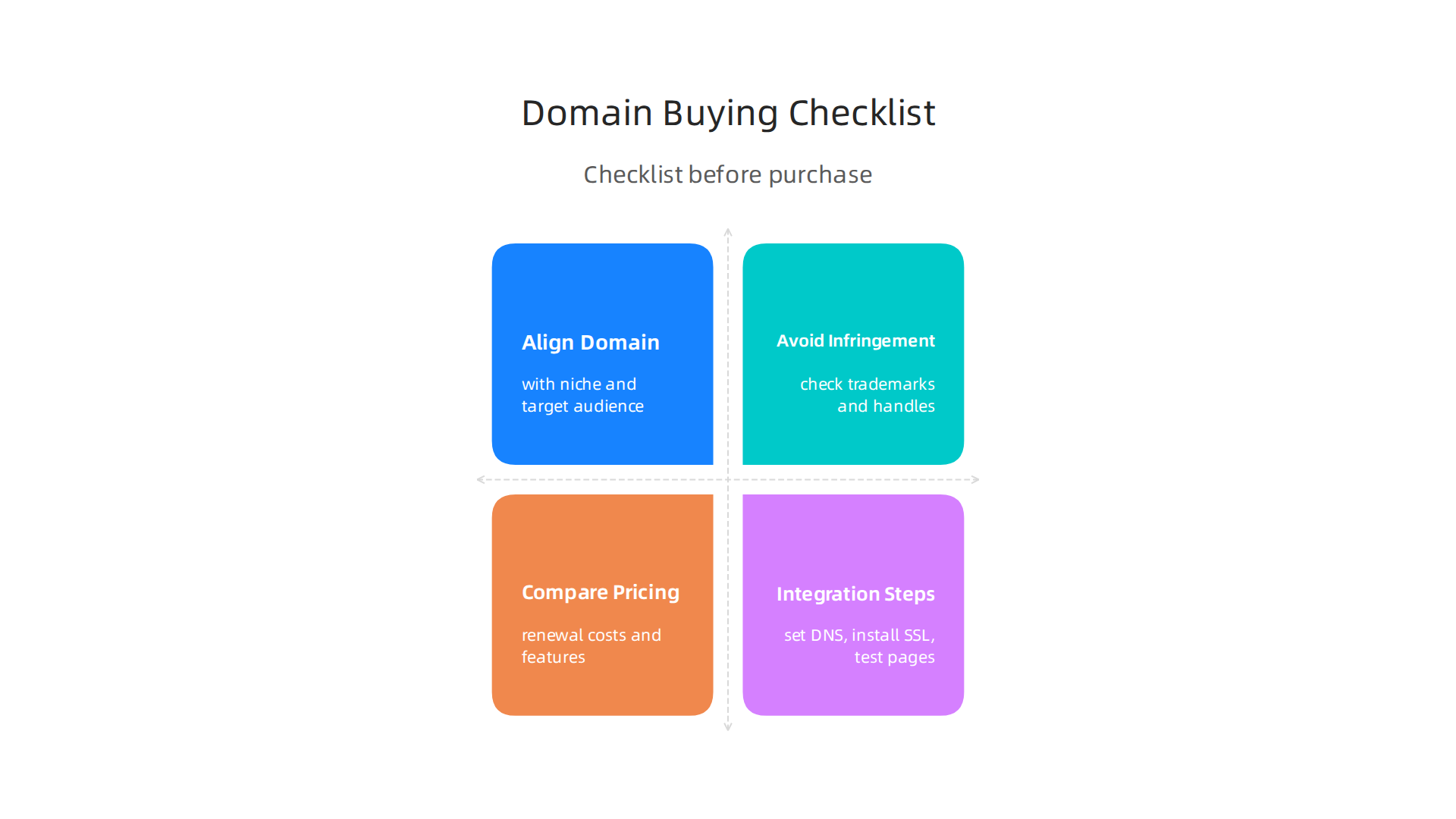
Align your domain with your niche and target audience. Your domain name should instantly tell visitors what your site is about. If you sell kitchen gadgets, "KitchenSmartHub.com" works better than "JohnsBlog2026.com." When your domain matches your niche, it feels natural. Search engines also notice. Google uses your domain as a relevance signal. So pick a name that fits your topic like a glove. If your niche is pet health, for example, a name like "HealthyPawsReview.com" sets the stage. You can then build content and promote products such as FitBark through your FitBark Affiliate Store right away.
Short, brandable names outperform keyword-stuffed domains over time. Beginners often jam their domain with keywords like "bestcheapkitchenknivesfor2026.com." That looks spammy and hard to remember. Instead, go for something short, catchy, and brandable. Think "KitchenSavvy.com" or "GearLab.com." These are easier to type, share, and trust. A brandable name also lets you expand your content later without sounding off topic. Plus, when you eventually build a brand, you own that space. Check out the 7 Best Registrars for Domain Investors in 2026 for comparisons that help you find affordable, brandable domains.
Check trademark databases and social handle availability before purchasing. This step is easy to skip but dangerous to ignore. In 2025, WIPO handled over 6,200 domain name disputes (source). Many of those were people who registered domains too close to existing trademarks. Imagine building a site for months, only to get a cease-and-desist letter. Prevent that. Use the USPTO trademark search or similar tools to see if your desired name conflicts with a registered trademark. Also check social media platforms. If the username is taken on Instagram, Twitter, or YouTube, your brand will look fragmented. You want the same handle everywhere. This consistency builds trust and makes it easier for people to find you.
Compare pricing, renewal costs, and features from top registrars. The first-year price can be tempting, but renewals often cost much more. For example, some registrars offer a .com domain for $1 the first year, then $15 at renewal. Others like NameSilo offer transparent pricing around $17.29 for both registration and renewal (source). Always check the renewal rate. Also look for free WHOIS privacy, easy DNS management, and reliable support. The 10 best domain name providers in 2026 list can help you compare these factors side by side.
Once you pick the right domain, your next step is to set up your site. You can learn how to build a site with Google for affiliate marketing and start turning your domain into a real income stream.
Remember: your domain is the first thing people see. Make it count.
How to Generate and Register Domain Names Efficiently
Now that you know what to look for in a domain, let us talk about the actual process. Generating and registering a domain name does not have to be a painful guessing game. There are real shortcuts that save you time and money. Here is how to do it efficiently.
Start with keyword research and niche brainstorming. You already have your niche in mind. Now write down the core terms people search for in that space. If you are in pet health, words like "paws," "healthy," "vet," or "petcare" are solid building blocks. Combine them with your brand idea. Use Google’s Keyword Planner or free tools like Ubersuggest to see what people actually type into search boxes. This gives you a list of phrases that already have demand. Then mix and match until you have a shortlist of possible names. For example, "HealthyPawsReview.com" or "PetCareGuide.net." This method keeps your domain relevant from day one.
Compare registrar features side by side. Not all registrars are the same. You need to look at pricing, privacy protection, DNS management, and API access if you plan to manage multiple domains. The best domain registrars of 2026 overview from GoDaddy helps you see how different platforms stack up. Some registrars offer free WHOIS privacy, while others charge extra. Some have easy DNS editing, others require more technical skill. If you are buying domain names for a portfolio, you also want reliable API access for bulk management. Check the 10 best domain name providers in 2026 for a detailed feature comparison that breaks down renewal costs and security features.
Use domain generators and backorder tools to speed things up. Here is the thing. Thousands of good domains get registered every day. You need to act fast. Tools like LeanDomainSearch or NameMesh let you enter your keywords and instantly see hundreds of available combinations. They filter by extension, length, and even rhyme. This cuts your brainstorming time from hours to minutes. If your ideal domain is taken, do not give up. Backorder tools like those offered by some registrars let you place a claim on an expiring domain. When the current owner lets it go, you get first dibs. This is a smart way to get premium names without paying premium prices. For a deeper look at investor-friendly tools, the 7 Best Registrars for Domain Investors in 2026 article covers portfolio management and backorder features.
One more tip: keep your list organized. Use a simple spreadsheet with columns for domain name, registrar, price, and status. This helps you track what you have and what you still need. When you find a winner, register it immediately. Do not wait.
Once you have your domain, the next step is building your site. You can learn exactly how to build a site with Google for affiliate marketing and start turning your domain into a real income stream.
The whole process of domain names buy and registration is faster than most people think. Use these tools, compare your options, and grab the name that fits your brand. Your future site will thank you.
Avoiding Costly Mistakes in Domain Registration
Registering a domain feels simple. You type in a name, pay a small fee, and you are done. But here is the thing. Small mistakes during the registration process can cost you a lot of time and money later. Let us look at the three biggest traps so you can avoid them when you buy domain names online.
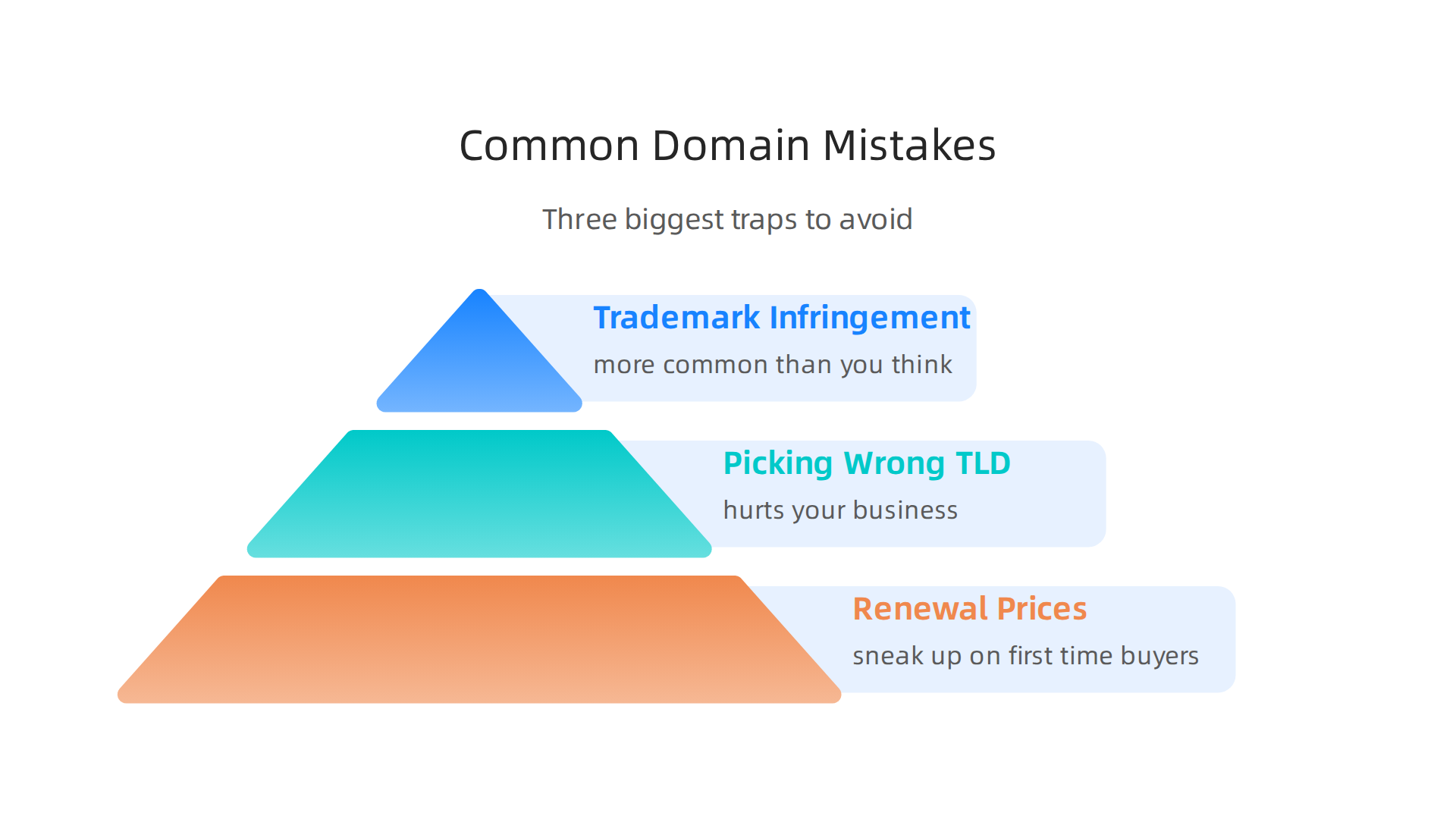
Trademark infringement is more common than you think. You might pick a name that sounds great without realizing it belongs to someone else. In 2025, the World Intellectual Property Organization (WIPO) handled over 6,200 domain name disputes, the highest number on record. That is a lot of people losing their domains because of trademark issues. If you register a name that copies a brand, you could get a legal order to hand it over. You could also lose all the traffic and income you built. Always search the USPTO trademark database and Google for your domain idea before you pay. A few minutes of checking now can save you from a huge headache later.
Picking the wrong TLD hurts your business. A TLD is the ending of your domain, like .com, .net, or .shop. Many new buyers grab a cheap or unusual TLD because .com is taken. That can hurt you in two ways. First, local TLDs like .us or .de help with local SEO if your audience is in one country. But a .biz or .info can look less trustworthy to visitors. People trust .com the most. If your goal is to build a long term site, a .com is almost always worth the extra search time. For a deeper breakdown of how TLDs affect your site, check out this guide on modern website design trends that boost conversions in 2026. It covers how every choice, including your domain, shapes user trust.
Renewal prices sneak up on first time buyers. Here is the mistake almost everyone makes. You see a domain for $2 or $3 in the first year and think it is a steal. But the renewal price might be $15 or $20 per year after that. Some registrars even charge $30 or more for certain TLDs. That cheap first year can turn into an expensive surprise. Always look at the renewal cost before you complete your purchase. Write it down in your spreadsheet. Set a calendar reminder to renew early so you do not lose the name. If you manage many domains, use a domain expiry checker to track all your renewal dates in one place. This simple habit prevents you from losing a valuable domain because you forgot to pay.
When you buy domain names for your affiliate sites, these three traps are the most common. Check for trademark conflicts. Choose a trusted TLD like .com. And always know your renewal price upfront. A little caution now means your domain stays yours for years to come.
Automating the Domain Buying Process for Multiple Sites
Buying one domain at a time is slow. When you want to scale, you might need five, ten, or even fifty domains.

Typing each name by hand, checking availability, and paying one by one wastes hours you could spend building content. The good news? In 2026, automation makes the whole process much faster.
API-based registration and bulk management save hours per domain. Many top registrars now offer application programming interfaces (APIs) that let you register domains with a single command. You write a script, plug in a list of names, and the system buys them for you. According to a comparison of the best domain registrars in 2026, services like GoDaddy and NameSilo provide bulk management tools and API access that let you manage hundreds of domains from one dashboard. Instead of logging in and out, you control everything through a central portfolio view. This is a must have if you plan to buy domain names in batches for affiliate sites.
Set up expired domain alerts to capture high-value assets. Some of the best domains are not for sale yet. They belong to someone who forgot to renew. You can use expired domain alerts to get a notification the moment a name drops. Registrars and third party tools watch for expiring domains with good backlinks, traffic, or brand value. When one pops up, you can grab it before anyone else. This is a smart way to find quality domain names without paying premium prices. Pair this with a domain expiry checker to keep your own renewals safe.
Automated naming scripts can generate hundreds of options in seconds. Staring at a blank search bar is painful. Instead, use name generation tools that mix keywords, prefixes, and available TLDs. You feed in your niche and get pages of ideas. Some scripts even check availability in real time. This speeds up the brainstorming phase and helps you find a domain names buy and sell opportunity faster.
Here is the thing. Automation only helps if you have a clear plan. The Automated Affiliate Method shows you how to build a repeatable system for affiliate marketing, from niche selection to automated growth. If you want to scale without burning out, start with a smarter domain buying workflow.
Integrating Your Domain into a Scalable Affiliate Workflow
Buying the domain is only the first step. Now you need to connect it to the right tools so it actually works for your business. Think of your domain name as the front door. If the locks are weak, the lights are off, and the address is hard to find, nobody stays inside. Here is how to set everything up the right way in 2026.
Configure DNS, hosting, and SSL for speed and security first.
Your Domain Name System (DNS) settings tell the internet where to find your site. If those settings are slow, your site loads slowly. And slow sites kill affiliate commissions. According to best practices for Cloud DNS, using a reliable DNS provider with low lookup times can dramatically improve page speed. Most registrars offer free DNS management, but you might want a dedicated DNS service for better performance.
Hosting matters even more. Cheap shared hosting can ruin a fast domain. Instead, look at a VPS setup with a modern control panel, as recommended in the 2026 Official Hosting Recommendation. This gives you dedicated resources and faster load times. Once your hosting is live, install a free SSL certificate right away. SSL encrypts data between your visitors and your server. It also helps your rankings. Google now flags sites without SSL as "Not Secure," which scares visitors away. If you need to move a domain, learn how to transfer domain name from GoDaddy to Squarespace in 2026 without breaking your SEO.
Connect your domain to content management systems and affiliate platforms.
Your domain should plug into your CMS (like WordPress or Shopify) in minutes. Most hosts offer one click installs. After that, link your domain to the affiliate networks you joined. This usually means adding a few DNS records provided by the affiliate platform. For example, if you use Cloudflare, you can set up a Cloudflare redirect domain for your affiliate site to point traffic exactly where you want it. A clean connection here prevents broken links and lost commissions.
Standardize a checklist for each new site to reduce manual errors.
When you manage multiple affiliate sites, mistakes happen fast. You might forget to install SSL on one site or point DNS to the wrong server. A simple checklist stops these errors. Here is what to include:
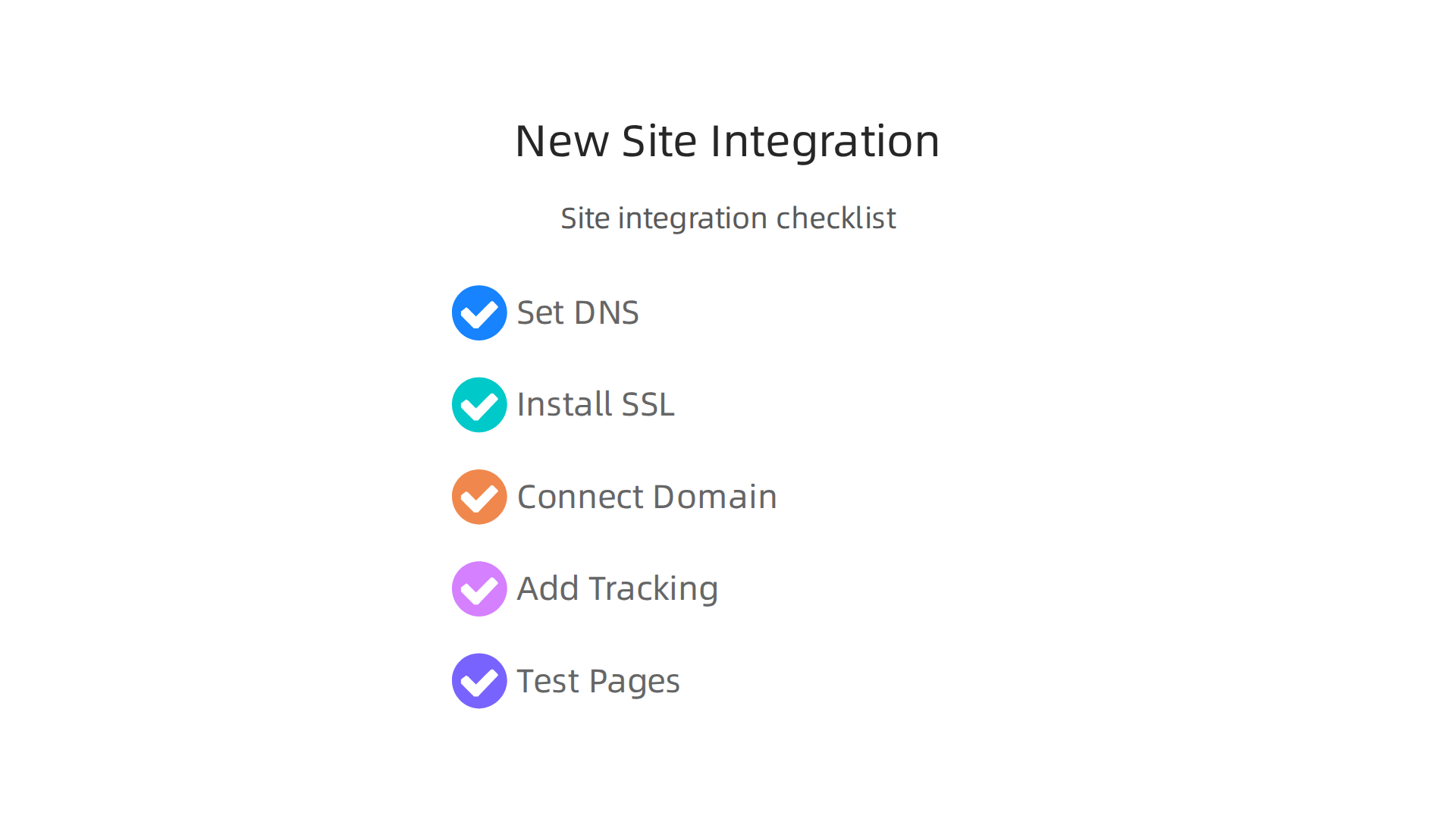
- Set DNS records (A, CNAME, MX) according to your host
- Install SSL certificate and verify HTTPS works
- Connect your domain to your CMS and confirm login access
- Add tracking codes from affiliate programs
- Test a few key pages for load speed and broken links
Using a standardized workflow saves you hours per site. For a deeper comparison of DNS providers, check out GoDaddy vs Route 53 for affiliate marketers. The right DNS and hosting setup turns a simple domain names buy into a fully functional income machine.
Once your tech stack is solid, you can focus on creating content and driving traffic. A repeatable integration process removes the friction and lets you scale faster.
Summary
This article explains why your domain name is the single most important asset for affiliate sites and gives a step‑by‑step approach to choosing, buying, and managing domains at scale. You’ll learn why a short, brandable .com improves trust, how domain names affect SEO, and which checks—trademark, social handles, and renewal costs—you must run before purchasing. The guide walks through efficient name generation, registrar comparisons, backorder strategies, and automation options like registrar APIs for bulk buys. It warns of common traps (wrong TLDs, hidden renewal fees, trademark disputes) and shows how to integrate your domain into a reliable tech stack by configuring DNS, hosting, and SSL. By following the checklist and automation tips here, you’ll protect your brand, reduce manual work, and speed up launching profitable affiliate sites.